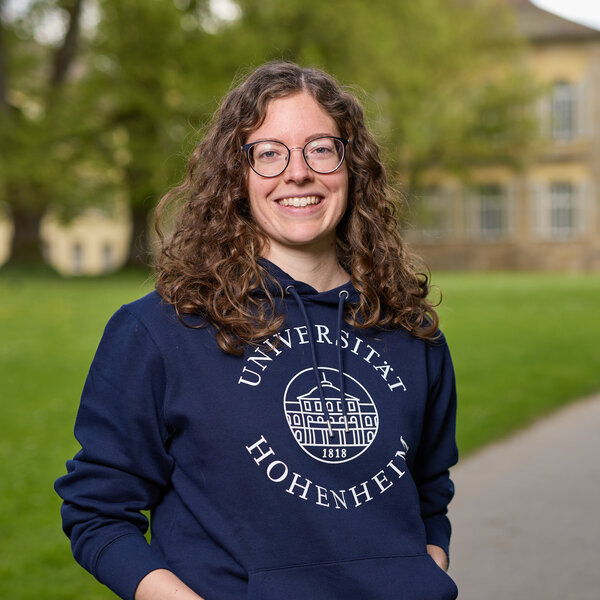
Anna-Lena Müller-Wengerofsky
Personal Advisor to the President
Ms. Müller-Wengerofsky, from spring 2024 to spring 2026, you served as the first Director of the University of Hohenheim’s Green Office. Can you tell us how the Green Office came to be established at the university?
The Green Office is a wonderful collaborative project. It began with the student body’s idea of establishing a sustainability office at Hohenheim, followed by structural and organizational planning in both academic support services and the academic community, and ultimately the dedicated efforts of people who are passionate about sustainability. Of course, setting up an entirely new unit can be challenging. Fortunately, I quickly realized that there was both a strong desire and a great deal of commitment at Hohenheim to bring the various ‘strands’ of sustainability together. This support was always incredibly motivating and inspiring. Particularly in the early days, having such close ties to the President’s Office was immensely important – and, of course, I was in an ideal position in that respect as the President’s Personal Advisor. It enabled us to establish the fundamental structures we needed, and the Green Office is now in a strong position.
What specific responsibilities did the Green Office ultimately take on, and what does the work involved in leading this kind of sustainability office look like?
At the Green Office, we bring together sustainability activities from across the university, enhance their visibility, and connect the people involved with a view to creating synergies. Through a variety of workshops, activities, and projects, as well as our presence at university-wide events, we raise awareness of sustainability. Our aim is to make the university even more sustainable and to establish a culture of sustainability across campus.
Over time, we built up a small team in which everyone contributes to making the university even more sustainable – for example, by supporting our Green Teams, planning events, handling internal and external communications, networking, and much more. In addition to responsibility for staff and the budget, an important part of the role is the continued development of the Green Office and, more generally, the way in which we approach sustainability. And of course, leading the office also means dealing with the challenges – both large and small – that I’m sure we all recognize from our everyday working lives, whether that’s angry emails, technology that refuses to cooperate, or packages that go missing.
The Green Office was renovated last year, which we were absolutely delighted about. However, the renovation work took considerably longer than planned. As a result, we had to postpone several events, and new students in particular were unable to get to know the Green Office in the way we had hoped. It therefore remains important to keep sharing information about sustainability in general, as well as about our Green Office, across campus.
What specific measures or projects from your time at the Green Office stand out as particularly memorable?
It was always very important to me to connect colleagues from different areas and bring them into dialog with one another. At the Green Office, professors, staff from academic support services, students, and others all sit around the same table – something that rarely happens in everyday university life. This creates a great opportunity to resolve issues quickly and informally, whereas without the Green Teams lengthy email exchanges or endless back-and-forth phone calls are often required. I was particularly impressed by how productive the Green Teams were and by the way different perspectives could be brought together to create well-coordinated projects. In many cases, we realized that the process itself was just as important as the end result, as it helped build a much better understanding of other people’s perspectives and the reasons behind them. More generally, there are so many good ideas at Hohenheim. We don’t always need to reinvent the wheel – we simply need to talk to one another more often.
Another highlight was definitely working with the student employees, who very quickly identified with the Green Office and, after a short settling-in period, began contributing their own ideas. Seeing this repeatedly inspired me to think outside the box.
I honestly could not choose one specific project. Each and every one of them has been rewarding in its own way: we learned something from each one, and I look back fondly on all of them: the Sustainability Challenge, sustainability factsheets, workshops for students, lecturers, and staff, GreenTalks, GreenReading, Dies Academicus and the Open Day, the start-of-semester fair, the Library of Things, Green Event BW, and many more. And of course, one project that particularly deserves to be highlighted is the sustainability strategy developed through a participatory process.
You mentioned earlier that you served both as Personal Advisor to the President and as Director of the Green Office. What role did this dual position play in getting the Green Office established?
It was personally very important to me to turn the idea of a sustainability office into reality. There were already some great ideas and a lot of good groundwork in place. These needed to be organized, completed, and presented in a structured way to the relevant bodies so that the idea could actually be put into practice. From my perspective, the close ties to university leadership and the direct line to the President were particularly important in the early stages. They helped us coordinate the launch effectively, move the development of the Green Office forward quickly and ensure it was on a sound footing for the future. To give sustainability even greater visibility and ensure that it held a permanent place in decision-making processes within the university’s governing bodies, we also expanded what was then the Vice President’s Office for Digital Transformation to include sustainability.
You are now once again working full-time as Personal Advisor to President Christoph Schneider. What role do sustainability considerations play in your current work?
I greatly valued those two years spent developing and coordinating the Green Office, and above all the personal collaboration and encountering the many different perspectives across our campus. I’m glad that, together, we were able to create strong structures that ensure sustainability is taken into account across all areas rather than simply being added on top. Sustainability is an issue that affects us all and one that we can only address together. It continues to play an important role in my work as Personal Advisor as well. The President frequently receives inquiries from higher education policymakers, businesses, and members of the public. These naturally often concern the environmental dimensions of sustainability, but also the economic – and increasingly the social – dimensions. Within our own team, too, we regularly ask ourselves how we can become even more sustainable and, for example, continue moving closer to our goal of becoming an almost paperless office.
I’ll probably also find it hard to resist dropping in on our Green Teams from time to time, because that sense of working together, developing ideas, and ultimately seeing what we have achieved together is always incredibly rewarding.
At this point, I would once again like to express my heartfelt thanks to everyone at Hohenheim who is committed to sustainability for the wonderful collaboration and for every individual contribution that helps make our university even more sustainable.
Thank you for speaking with us!
February 2026