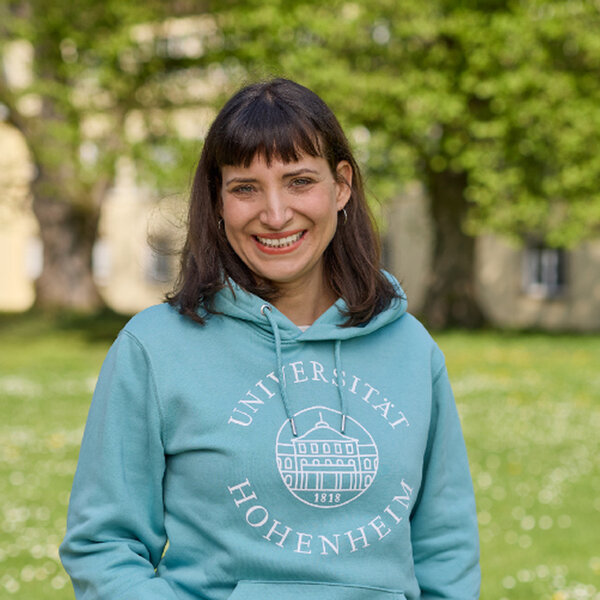
Verena Hüttl-Maack
Gender Equality Representative for the academic sector
Gender equality forms part of the United Nations’ global Sustainable Development Goals: it is SDG No. 5. What does the concept actually mean for us as a university? What are we working toward when we aim for greater gender equality in Hohenheim?
For us, gender equality is not about treating everyone identically. It is about ensuring that everyone has the same chances to participate and succeed, regardless of gender. Universities developed over long periods with structures and career models that were largely shaped around male life paths. Even now, the demands of an academic career can clash with family responsibilities and create unequal hurdles. A male bias also persists in how performance is perceived: Women researchers and their outstanding work often receive less visibility and recognition both publicly and within their fields. If we want to advance gender equality in Hohenheim, we must first make these barriers visible and then actively remove them.
Where does the University of Hohenheim currently stand on these issues? What do you see as the biggest challenges in this area?
We have made solid progress in recent years. In 2025, the share of female professors reached a record 30.8 percent. Yet when you set that figure against the nearly 60 percent of women among our graduates, it no longer looks quite as strong. A proportion of just over 30 percent is simply not enough. We are clearly not yet succeeding in carrying the full potential of women researchers all the way through to the professorship. To attract more women into these positions, we need to look closely at the transition points between qualification stages and understand where — and why — women leave the academic path. Only then can we purposefully improve the conditions that support them.
You hold the role of University Gender Equality Representative alongside your main position as director of the Department of Marketing and Consumer Behavior. Could you describe your responsibilities and daily work a little? Which structures and individuals do you collaborate with most closely?
The role is highly varied and depends on close cooperation with many colleagues. I work especially closely with our consultant for gender equality, Regina Rapp, and the team in the Gender Equality and Diversity Office. Together, we develop strategic topics such as the gender equality concept and diversity initiatives, and we design measures under the female professors’ program. I also advise staff and committees on gender-equality questions and represent the university in networks that link higher-education institutions.
What aspects of the work frustrate you, and what encourages you most?
What weighs on me most is how long change can take at universities. We do see progress in raising the share of female professors, yet structural shifts simply do not happen overnight. At the same time, I find it genuinely encouraging that gender equality is treated as a shared responsibility here in Hohenheim. I encounter real openness and a university leadership that actively supports the topic and clearly underlines its importance. There is also a willingness to question existing structures and develop them further. That attitude, in my view, is the essential foundation for lasting change.
What three things would you most like to see from every member of the Hohenheim community to foster an even stronger culture of equal opportunity, diversity, and tolerance?
I hope we all make a repeated, conscious effort to see situations through other people’s eyes. Taking another perspective often builds greater understanding of different experiences and needs.
I also hope for more open conversation and genuine listening. Sometimes we simply need to talk with one another more, listen carefully, and stay in dialogue.
Thank you for the conversation!
Updated: June 2026